Public speaking

You’ve probably heard this Seinfeld joke:


According to most studies, people’s number one fear is public speaking. Number two is death. Death is number two. Does that sound right? This means to the average person, if you go to a funeral, you’re better off in the casket than doing the eulogy.


Knowing humans, this shouldn’t be that surprising. I’ve mentioned before that we all have this problem where we’re weirdly obsessed with what other people think of us, so it makes sense that public speaking should be our collective phobia.

Read this very interesting text by Tim Urban about public speaking, which can be very useful for scientists:  Doing a TED Talk

Rationalizing the unreasonable: there are no good academics in the EU

A very interesting text, by Jan Blommaert:

“... We had set up an international consortium earlier on, did profound content preparation, and one of our team members spent hundreds of hours and several international trips worth several thousands of Euros preparing the application. (…)

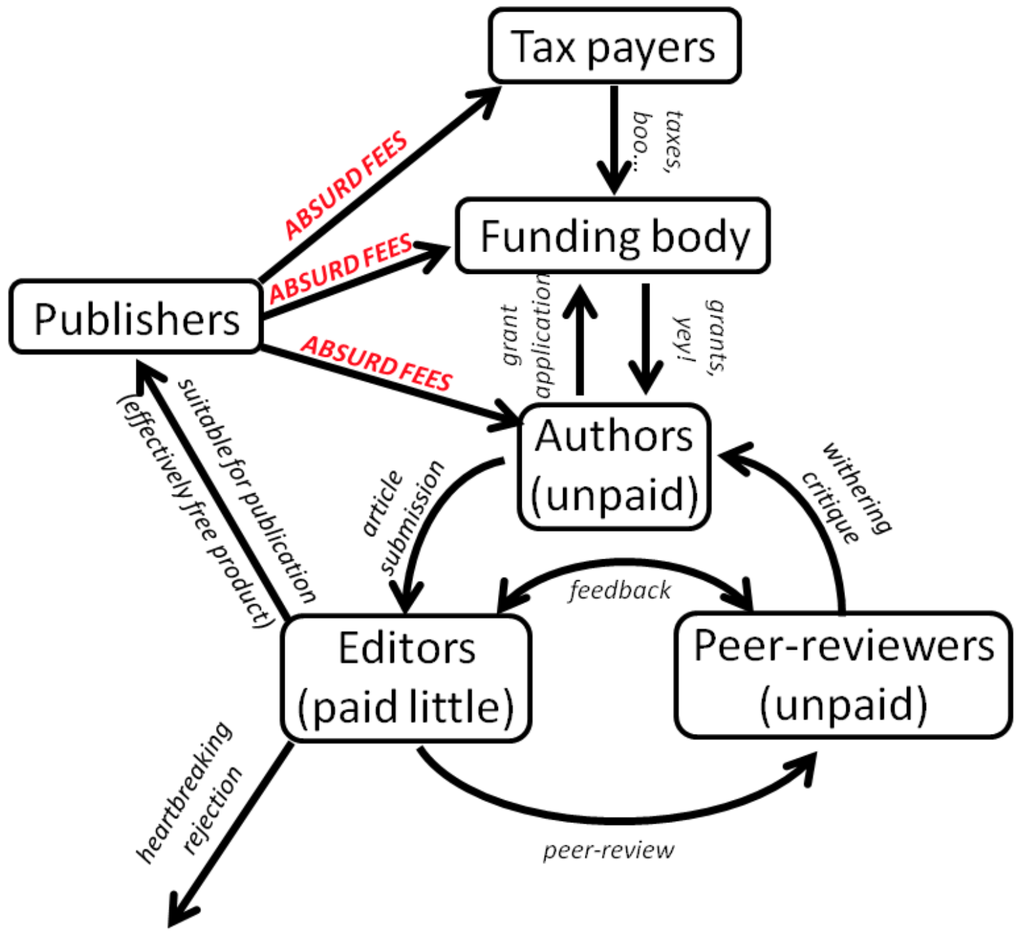
My guess is that many millions’ worth of (usually) taxpayers’ money will have been used – wasted – in this massive and mass grantwriting effort. Several hundreds of researchers will have been involved, each spending dozens if not hundreds of their salaried working hours on preparing the application, and hundreds of university administrators will have been involved as well, also spending salaried working hours on the applications. These millions of Euros have not been used in creative and innovative research – they weren’t spent on doing fieldwork, experiments or tests, nor on writing papers and holding presentations in workshops and symposiums. They were spent on – nothing.  (…)

By awarding just 1,3% of the applications, thus, a rather thoroughly absurd reality is shaped: almost 99% of the competing academics in the EU do not make the mark, and just 1,3% satisfies the EU benchmark. Now, we know that the 98,7% “losers” still have to compete in order to show that they are good enough; but when a selection bottleneck is thàt narrow, the effort, and the resources invested into it, are in effect simply wasted.

The paradox is clear: by going along with the stampede of competitive external funding acquisition, almost all universities across the EU will lose not just money, but extremely valuable research time for their staff. (…)

Read the complete text: https://alternative-democracy-research.org/2015/06/10/rationalizing-the-unreasonable-there-are-no-good-academics-in-the-eu/

 

Una mujer por cada nueve hombres en la élite de la ciencia europea

La élite de la ciencia en Europa sigue siendo, casi en exclusiva, cosa de hombres. Los últimos resultados de uno de los programas más prestigiosos de la UE para financiar a científicos ya consagrados así lo demuestra. Solo uno de cada 10 investigadores galardonados en la última edición de las Advanced Grants del Consejo Europeo de Investigación (ERC) es mujer. La diferencia entre sexos registrada este año es aún mayor de lo habitual. En España, entre los 13 investigadores que han conseguido este apoyo financiero, solo hay una mujer: Teresa Puig, del Instituto de Ciencia de Materiales de Barcelona.

Leer más


Continúa la sangría

Galicia ha perdido 1287 investigadores en los últimos cuatro años, según esta noticia.

La caída a los abismos del I+D+1 en Galicia tiene su reflejo en la posición que ocupaba la comunidad dentro del conjunto estatal. (…) En España, la media se sitúa en el 1,24 %, un porcentaje que es casi la mitad del gasto en investigación del promedio europeo y que está muy lejos del objetivo del 2 % que se ha marcado el Gobierno para el 2020 en la Estrategia Española de Ciencia y Tecnología. Solo el País Vasco, con un porcentaje del 2,09 % sobre el PIB, alcanza la media comunitaria.